



No Lectures.
No Teachers.
Just Real Work.

peer-to-peer

GV Academy uses a project-based, peer-to-peer methodology — the same approach used by the world's top engineering schools.

You learn by solving real problems, reviewing your peers' code, and building things that actually work.

Zero lectures, ever
There are no teachers standing at a board and no slides to memorize. Every concept you learn comes from solving an actual project — the only way to build real intuition for code.
Industry-level projects
Our projects mirror the actual tasks engineers solve at companies like Google, Amazon, and Microsoft — not toy exercises. Finish the program and you'll have a portfolio of work that speaks for itself.
Peer-to-peer reviews
Every project is reviewed by other participants — not a teacher. You learn to give constructive feedback, explain your choices, and defend your work. These are the skills companies hire for.
Campus open 24/7
GV Academy campuses are open every hour of every day, 365 days a year. You set your schedule. Early mornings, late nights, weekends — your learning never has to stop.

We build engineers who think like engineers — not students who memorized the right answers

At GV Academy, participants work on projects that demand real decisions: design choices, debugging under pressure, collaboration under ambiguity. There is no answer key. You discover the solution the same way a working engineer does — by thinking it through, testing it, and learning from what breaks.

Apply to GV Academy
0
Teachers. Zero. Learning is entirely peer-driven.
100%
Project-based. Every concept comes from doing, not watching.
Learning Tracks

In the main program you can choose one of 10 tracks

C, Unix, and Algorithms
You start at the lowest level — memory management in C, shell scripts, and Unix processes. No shortcuts. This foundation makes everything that follows feel intuitive and gives you a massive advantage over developers who skipped it.
System design and architecture
Design systems that handle real load. You'll model data flows, choose storage strategies, and defend your architecture in peer reviews — the same way engineers do in technical design meetings.
Web development and APIs
Build full-stack web applications from scratch. You'll design REST and GraphQL APIs, handle authentication, manage state, and deploy to production — all on your own initiative, with peers reviewing your every decision.
Networking and security
Implement network protocols from the ground up and secure your applications against real attack vectors. Understanding how networks work at a low level sets great developers apart from average ones.
Databases and data modeling
Design, query, and optimize relational and non-relational databases. You'll work with PostgreSQL, Redis, and time-series data — handling the problems that slow down real production systems.
Team and collaborative projects
Work on larger projects with a team of peers — coordinate tasks using Git, manage merge conflicts, write documentation, and ship working software on a deadline. This is as close to a real job as education gets.
DevOps and deployment
Containerize applications with Docker, set up CI/CD pipelines, and monitor production systems. Even if you're on the development track, understanding deployment makes you dramatically more effective on any team.
Career portfolio projects
In the final phase, you build a complete project that demonstrates everything you've learned. It becomes the centerpiece of your portfolio — something concrete you can show hiring managers and discuss in technical interviews.

Plus full preparation

for your

first IT job

Career Track

A dedicated career track runs alongside your technical training. You'll write a professional resume, practise technical interviews with peers, and learn how to navigate the hiring process at leading IT companies.

Internship
A mandatory 3-month internship at a real IT company is built into the program. You find the placement yourself — the school supports the process — and most participants receive a job offer before the internship ends.

Anyone can learn here —
no prior knowledge required
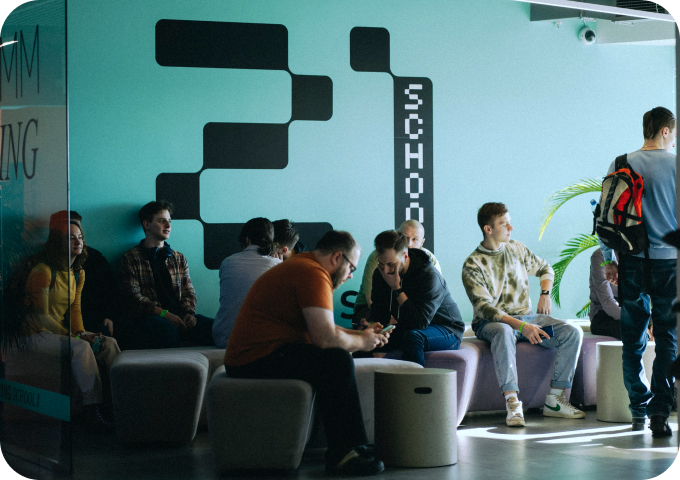
The peer-to-peer method works for everyone — regardless of background, age, or what you studied before. What matters is curiosity and the willingness to put in the time. The methodology does the rest.
Your own schedule
The campus is open 24/7. Minimum commitment is 20 hours per week — when and how is entirely up to you
No programming required
Half of our participants arrive with zero coding experience. The methodology is designed for that
Learn by reviewing others
Every project you complete gets reviewed by peers — and you review theirs. Teaching accelerates your own learning
Progress through XP
The platform tracks your progress through experience points, levels, and achievements — motivation built into the system
Apply to GV Academy
Students collaborating at GV Academy
50%
of participants arrived with no programming experience at all
Learning Phases

Four phases take you from zero to employed

Apply
Phase 1 3–4 months
Foundation

Master the basics: C programming, Unix, shell, algorithms, and data structures. You'll build things from scratch — no libraries, no shortcuts.

On campus
Phase 2 6–9 months
Core Projects

Tackle track-specific projects — web apps, data pipelines, security tools, or UX prototypes. Each one reviewed by peers before you can advance.

On campus
Phase 3 2–3 months
Career Track

Build your portfolio project, write your resume, and go through mock technical interviews with peers. The school introduces you to hiring partners.

On campus + online
Phase 4 3 months
Internship

A mandatory placement at a real IT company. Most participants receive a permanent job offer before their 3 months are up.

At a partner company
Daily Learning

From day one, you're doing real work

GV Academy campus
20 hrs
minimum per week — flexible, on your terms
Day 1
you start your first project — no orientation lectures
No teachers, ever
You won't find a teacher at GV Academy — not a single one. Everything you learn comes from the project itself, from the feedback of peers, and from the satisfaction of making something work.
Real engineering tasks

Our projects are designed with industry partners to mirror what junior and mid-level engineers actually do. Nothing is simplified for classroom consumption — you solve the real problem or you go back and try again.

Peer code reviews
Every project requires at least two successful peer reviews before you earn your XP and move on. Reviewing other people's code teaches you as much as writing your own — often more.
XP and game mechanics

The platform tracks your progress through experience points, levels, and achievements. Every review you give earns you XP. Every project you pass levels you up. It feels like a game — because it is, but the skills are completely real.

Employment

Internship at a real company — 3 months

The internship is a formal part of the GV Academy program — not optional, not extra. You'll spend 3 months at a partner company working on production tasks. You find the placement yourself (the school helps if needed), and you work a minimum of 20 hours per week.

Most participants receive a permanent offer before the 3 months are up. The internship is where classroom skills become a career.


100%
of graduates receive at least one job offer
GV Academy
Sibur
Ozon
Okko
Skolkovo
RZD
Gazprom
Yandex
Kaspersky
Samokat
Methodology

We develop technical skills alongside the human skills that make great engineers

iconTeamwork and collaboration
iconPresenting and defending ideas
iconSelf-direction and discipline
iconAgile and Scrum thinking
iconProblem-solving under pressure
iconGiving and receiving feedback
Read graduate stories
Apply to GV Academy

Start building your IT career today

Choose a campus and training track, create your account, and you can immediately take the entrance game and sign up for the selection pool
Choose a campus
Choose a track
You can change your track before training starts